


Dog Boarding vs Pet Sitting

Share


When you're planning time away, the choice between dog boarding and pet sitting usually comes down to where your pet is happiest and best looked after. Boarding takes your pet to a caregiver, either a pet resort or someone's home. Pet sitting brings the care to your pet, in the place they already know. Both can be a wonderful fit, and the right answer depends on your particular animal and your particular trip.
A quick word on terminology before we go further, because it gets muddled all over the internet. In-home boarding, where your dog stays overnight in a caregiver's home, is its own thing, separate from facility boarding and separate from a sitter who comes to your house. Keeping those three straight will save you a fair amount of confusion as you compare options.
As you read, weigh the factors that move the decision, such as your pet's environment, daily routine, social comfort, level of supervision, health needs, whatever the household needs while you're gone, how well the provider fits, and the total cost. The comparison table and checklist below are here to help you line all of that up, instead of picking by the lowest nightly rate and hoping for the best.
What Is Dog Boarding?
Boarding means your pet stays somewhere else overnight while you're away. It comes in two main forms, and the gap between them is wider than it sounds.
- Pet resort or facility boarding. Your pet stays at a dedicated care location with staff, kennels or suites, and often group play or enrichment on offer.
- In-home boarding. Your pet stays in a caregiver's own home, which tends to feel more like a household and less like a facility.
What's included ranges widely from one provider to the next. Lodging, playtime, walks, feeding, overnight staffing, and the sleeping setup can all look different depending on where you book, so it helps to ask a few specific questions before you commit. Find out how much group interaction your pet will have, where and how they'll rest, what the enclosure or room looks like, how closely the animals are monitored, and how pickup works.
Provider insight placeholder: What differences between pet resort and in-home boarding matter most to pet parents?
What Is Pet Sitting?
With pet sitting, the caregiver comes to your pet instead of the other way around. Your animal stays home, and someone looks after them there. It also splits into two common formats.
- Overnight house sitting. A sitter stays in your home, or spends agreed overnight hours there, so your pet has company through the night.
- Drop-in visits. A sitter stops by on a set schedule to feed, walk, tidy up, and check in, without staying continuously or overnight.
The details are where people get tripped up. Visit length, how long the overnight window runs, how much of the day the sitter is away, whether walks are included, and which household tasks are covered all change from sitter to sitter.
Being at home doesn't automatically mean around-the-clock company, so it's a good idea to put the arrangement in writing. Agree up front on arrival and departure times, where the sitter sleeps, how they get into your home, whether cameras are in use, the guest policy, and what happens in an emergency.
Provider insight placeholder: Which scheduling details should clients confirm before assuming a sitting service includes continuous care?
Dog Boarding vs. Pet Sitting at a Glance
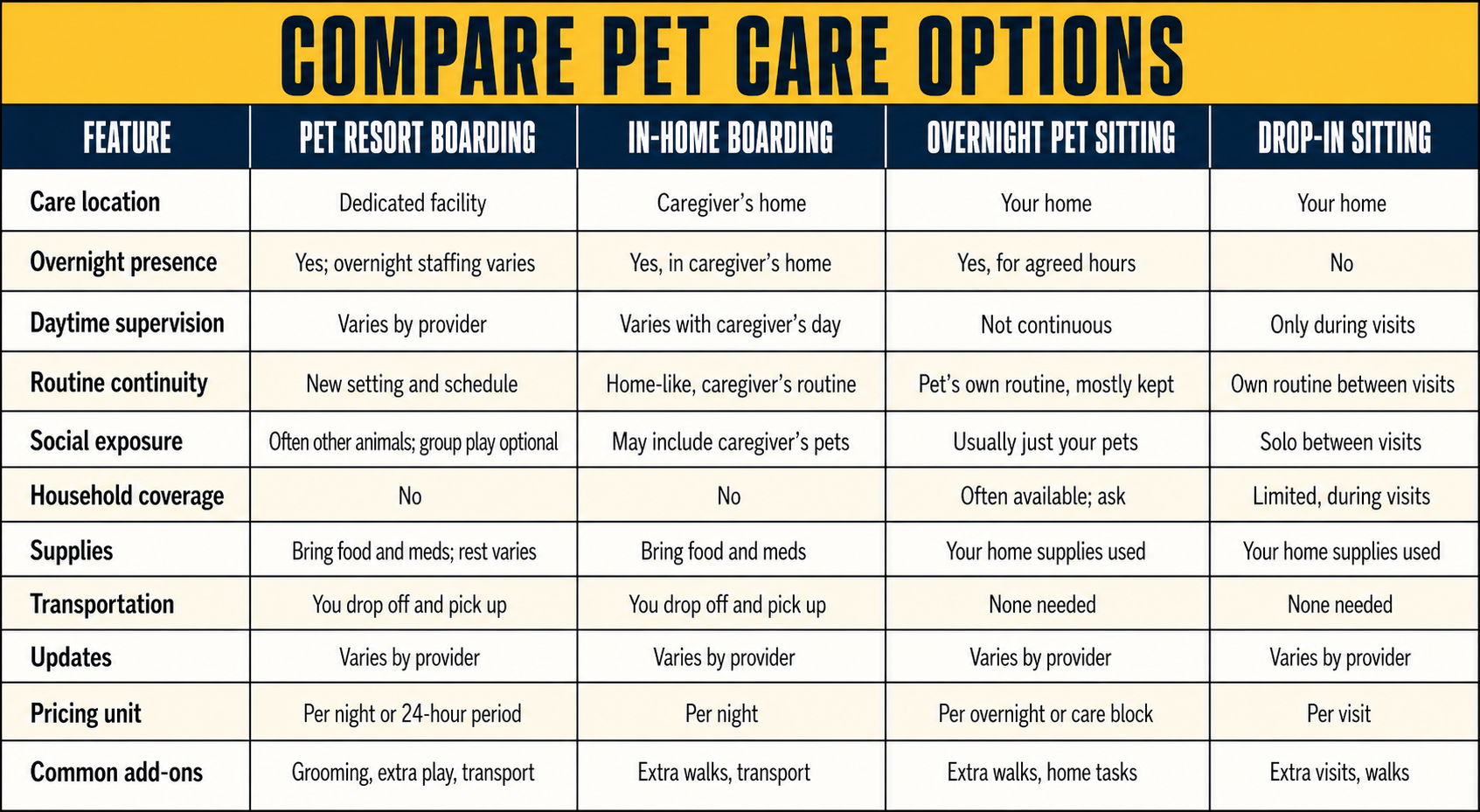
Here's how the four common care models stack up side by side. The table describes what each option typically looks like rather than crowning a winner, since the best choice changes with the pet. Wherever there's no across-the-board answer, you'll see "varies by provider," which is your cue to ask.
Which Pets May Prefer Boarding?
Some pets take a change of scenery in stride, and a few clearly relish it. Boarding tends to suit:
- Pets who leave home easily and settle into a structured setting without much fuss.
- Dogs who like the social time or enrichment a good provider offers, when that's their kind of fun.
- Households that would rather have a dedicated care location and don't need anyone looking after the house.
- Pets whose needs line up with the provider's staffing, accommodations, and hands-on experience.
Being shy, picky, older, or medically complex doesn't rule boarding out, by the way. Plenty of these pets do beautifully with an individualized setup and a provider who's ready for them. The fit comes down to the specific provider more than the category.
Provider insight placeholder: What signs suggest a particular pet is likely to be comfortable in your boarding environment?
Which Pets May Prefer Pet Sitting?
Other pets are happiest in their own space, and for them, keeping the caregiver at home makes more sense. Sitting often works well for:
- Pets who lean heavily on familiar surroundings or a set household routine to feel secure.
- Multi-pet homes that would be tricky to transport or split up.
- Cats, seniors, mobility-limited pets, or animals with home-based care routines, depending on the sitter's experience.
- Households that also need the mail brought in, plants watered, or a lived-in look while you're away.
Anxious dogs are a common reason people lean toward sitting, and there's good sense in it. A nervous dog who already feels safe at home is spared the stress of a new place on top of your absence. Even so, it isn't a universal rule. Some anxious dogs settle better with the steady company and structure of a caregiver's home, especially when being alone is a big part of what worries them. The honest answer is that it depends on what's driving the anxiety, which is a good thing to talk through with your provider.
One more thing to keep in mind. A pet being home doesn't guarantee someone is watching them every hour, so match the visit schedule to how much company your pet truly needs.
Provider insight placeholder: Which pets tend to benefit most from remaining in their own home, and why?
Compare Supervision, Routine, and Social Environment
Once you have a sense of which direction suits your pet, compare the day-to-day realities of the options you're weighing. A few questions to consider:
- How long will your pet be alone, both during the day and overnight? The answer differs a lot between a staffed facility, a caregiver's home, and a sitter who steps out for stretches.
- How closely will feeding, medication, bathroom breaks, walks, play, and sleep follow your pet's normal schedule?
- Will other animals be around? Ask about group play, resident pets, staff changes, and how introductions are handled.
- What's the setting like for noise, confinement, and escape prevention, and how are updates and emergencies handled?
- Does the environment suit your pet's known behavior and handling needs, based on how they behave day to day rather than how you hope they'll behave?
Health, Medication, and Special-Care Needs
If your pet has any medical or behavioral needs, sort those out before you compare anything else, because they can narrow the field in a hurry.
- Share the full picture up front, including current conditions, allergies, medications, mobility needs, behavior concerns, and any recent symptoms.
- Ask what care the provider will take on, who administers it, how they document it, and where they'd turn for veterinary support.
- Compare how each option handles transportation and authorization for urgent or emergency vet care.
- Confirm the health-record and vaccine requirements for the specific care model and provider you're considering.
- Loop in your own vet when your pet's medical or behavior needs are significant.
The care model that looks perfect on paper can fall apart if the provider can't give a twice-daily injection or isn't set up for a dog who guards their food. Far better to learn that early.
Provider insight placeholder: Which special-care requests require the most advance planning or may change the recommended care setting?
Cost of Boarding vs. Pet Sitting
Price is rarely apples to apples, so it helps to understand how each service tends to be billed before you compare quotes.
Boarding is usually charged per night or per 24-hour period. Sitting might be priced per overnight stay, per visit, or as a block of continuous care, depending on the arrangement. On top of the base rate, plenty of things move the final number, including your city, the exact dates, how many pets you have, holiday demand, how much hands-on care is needed, medication, walks, transport, and late pickups.
Which one costs less will depend on the situation. A sitter can be economical for a multi-pet household, since you're often paying for the visit rather than per animal, while a boarding package with services included can come out ahead in other cases. The only fair comparison is a full quote for the same trip dates, the same pets, the same supervision expectations, and the same add-ons.
There's also a longer-term angle. Booking repeatedly through Yourgi earns rewards, with money back and the occasional perk the longer you stay with a Pro. [Placeholder: link to the Yourgi daycare and boarding cost guide once it's published.]
Questions to Ask a Boarding Provider or Pet Sitter
Whichever way you're leaning, the same handful of questions will tell you most of what you need to know. Bring these to any meet-and-greet or tour:
- Where will my pet sleep, eat, exercise, rest, and spend any time alone?
- Who will provide the care, and can I meet them or see the space first?
- How many pets or households are you caring for at once?
- What's included in the price, and what costs extra?
- How do you handle medications, behavior concerns, escapes, illness, and emergencies?
- How often will I get updates, and how do I reach you?
- What are your cancellation, pickup, home-access, and property policies?
A Simple Decision Checklist
When you're ready to decide, walk through it in order:
- Start with the service models available where you live.
- List your pet's non-negotiables for routine, supervision, health, handling, and environment.
- Meet the providers or tour the settings whenever you can.
- Compare written care plans and complete quotes for the same dates.
- Do a trial visit or short stay when it's appropriate and allowed.
- Choose the provider and setting that best fit your pet's needs, rather than the lowest starting rate.
Booking through a platform like Yourgi adds a layer of reassurance here, since every Yourgi Pro is vetted to one standard and backed by the Yourgi Guarantee, so a disappointing stay doesn't land entirely on you.
Frequently Asked Questions
Is boarding or pet sitting less stressful for dogs?
It depends on the dog. Home-loving dogs usually find sitting less stressful because nothing about their surroundings changes. Social, adaptable dogs often enjoy the activity of a good boarding setup. Stress level has more to do with the individual dog and the quality of care than with the format itself.
Is pet sitting better for an anxious dog?
Often, yes. An anxious dog who feels safe at home is spared the double stress of a new place and your absence. It isn't a hard rule, though. If your dog's anxiety is mostly about being alone, the steady company at a caregiver's home may suit them better. Think about what triggers the anxiety, then match the care to it.
Is boarding or pet sitting better for a senior pet?
Many senior pets do best at home, where the routine is familiar and there are no new stairs or surfaces to relearn. That said, a senior with a health condition might be safer somewhere with staff on hand overnight. The right call hinges on your pet's mobility and medical needs, and on how well they handle change.
What is the difference between in-home boarding and pet sitting?
In-home boarding means your pet goes to the caregiver's house and stays there. Pet sitting keeps your pet in your own home, with the caregiver coming to them. Both feel more home-like than a facility, but the location flips.
Does pet sitting mean someone stays overnight?
Not always. Overnight house sitting includes a caregiver staying the night, while drop-in sitting is just scheduled visits with no overnight presence. Confirm which one you're booking, because the difference in coverage is large.
Is boarding or pet sitting cheaper for multiple pets?
Sitting frequently wins here, since you're usually paying for the visit or the stay rather than per pet. Boarding often charges by the animal, which adds up fast with a full household. Get quotes both ways for your exact pets and dates to be sure.
Which option is better for cats?
Cats are famously attached to their territory, so most do better with sitting in their own home. Boarding can work for social or already-acclimated cats, especially at a provider experienced with felines. For a lot of cats, staying put is the gentler choice.
Can boarding providers or pet sitters give medication?
Many can, but never assume it. Ask specifically which medications they'll give and whether injections or time-sensitive doses are included, plus how they record each one. Complex regimens may call for a provider with more experience.
How far in advance should I book holiday care?
As early as you can manage. Good providers fill up quickly for holidays and peak travel weeks, sometimes months out. Booking early also gives you time for a meet-and-greet or trial visit before the dates arrive.
Should I schedule a trial stay or meet-and-greet?
Whenever it's offered, yes. A short trial run or an in-person meeting shows you how your pet responds and how the provider works, long before the trip itself. It's one of the simplest ways to book with confidence.