


Dog Boarding vs Pet Sitting for Holiday Travel

Share


Dog Boarding vs Pet Sitting: Which Is Better for Holiday Travel?
When you travel without your dog, the care question usually comes down to two paths. You can board your dog with a provider, or you can keep them home and bring care to them. Boarding can suit a dog who settles easily into a provider’s setting and a structured day, while a sitter can suit a dog who does best keeping to their own routine at home. The better choice depends on your dog, your household, the trip, and which qualified provider you can get.
Fall travel adds a few wrinkles rather than tipping the answer one way. Shorter days, wetter weather, school breaks, and holiday demand all touch things like walk times, pickup windows, availability, and your backup plan, so treat the season as a planning factor to weigh rather than a tiebreaker on its own.
The Short Answer
Compare the care, not the label. Two sitters, or two boarding facilities, can run very differently, so look at the specific provider in front of you: their supervision, routine, environment, communication, requirements, and how they handle an emergency.
In general, a dog who takes new environments in stride and meets a facility’s requirements may do well boarding, while a dog who gets stressed by change or needs the continuity of home may do better with a sitter. For a dog with significant anxiety, a complex medical history, a bite history, or a recent illness, bring your veterinarian or a qualified behavior professional into the decision before you book.
What Dog Boarding and Pet Sitting Mean
It helps to understand the terms first, since providers use them loosely. Dog boarding generally means your dog stays overnight somewhere else while you’re away, whether a pet resort, a boarding facility, or a caregiver’s own home.
Pet sitting splits into two fairly different arrangements. Drop-in visits mean a sitter comes to your home a set number of times a day to feed, walk, and check on your dog, while overnight house sitting means the sitter stays in your home through the night.
None of these labels are standardized, so confirm the specifics before you book. Ask where the care happens and how many hours your dog would be alone, and get a clear list of what’s included.
Compare the Two Options at a Glance
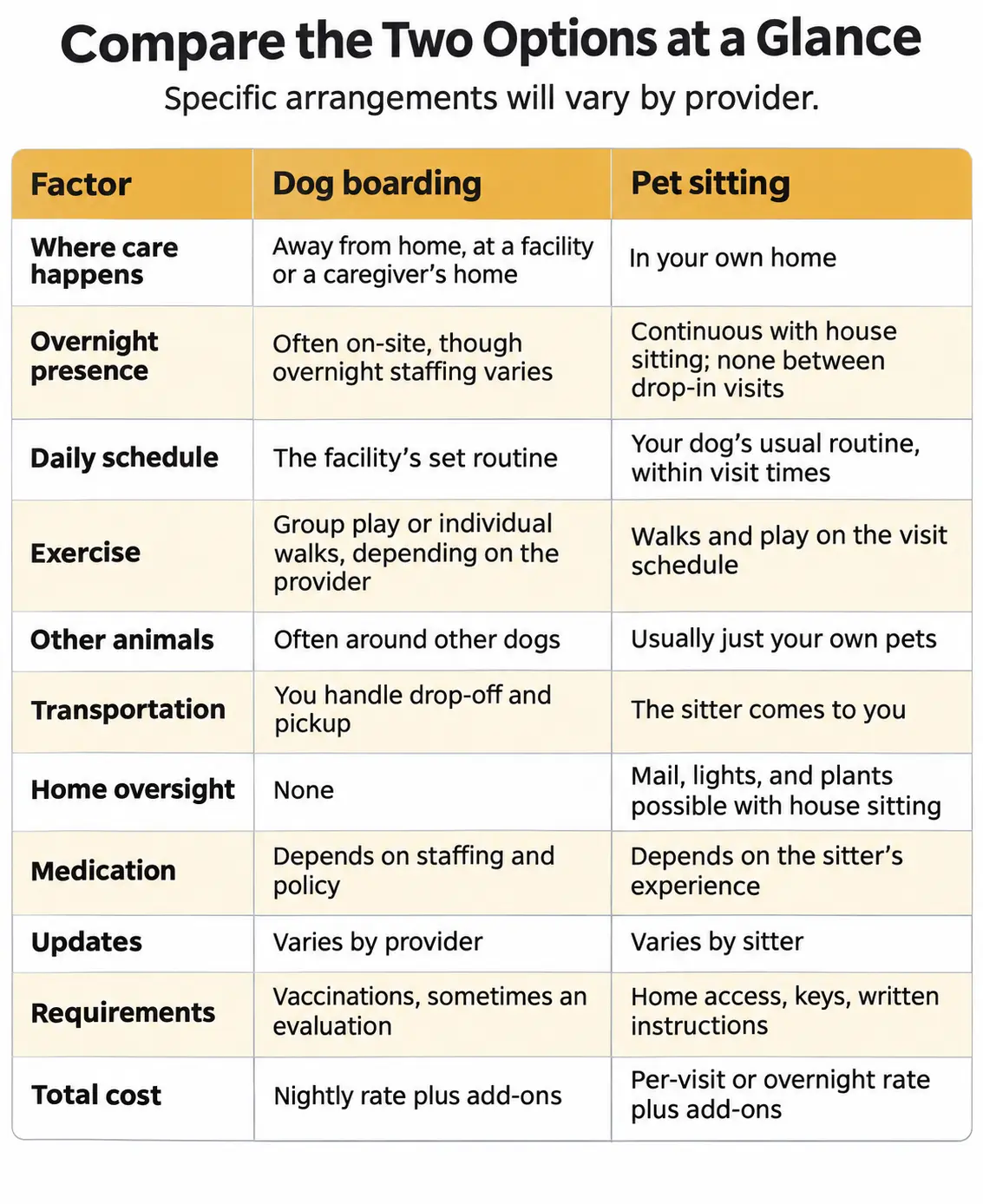
Once you’ve compared, ask the question that cuts through it. For this dog and this trip, which setting is more likely to keep them comfortable and safe while holding their routine and care quality steady?
When Dog Boarding May Be the Better Fit
Boarding tends to be best for the dog who travels well emotionally. If your dog enjoys new places, does fine around other dogs, and meets the facility’s requirements, a good boarding stay gives them a dedicated spot with people on hand and often some enrichment on the daily schedule.
It can also make life simpler when keeping care at your home isn’t workable, say your place will be inaccessible during a renovation, or when you don’t need anyone handling mail, plants, or lights while you’re gone.
Before you commit, get specific about the day. Confirm group-play eligibility, rest periods, feeding and sleeping arrangements, overnight supervision, and the medication policy, and ask whether the provider can give a dog individual care when a group setting isn’t the right fit.
When Pet Sitting May Be the Better Fit
Pet sitting wins when home is the thing your dog needs most. A dog who frets in unfamiliar places often does better with a sitter coming to them, and so does a multi-pet household that’s a hassle to move or a pet who runs on a strict home routine. Families who also want eyes on the house while they’re away get that as a bonus with overnight sitting.
The piece to nail down is how much alone time the arrangement leaves. Ask whether you’re getting drop-in visits or an overnight house sitter, and how many hours your dog would be on their own between visits.
From there, work through the home logistics. Cover walking plans, entry and alarm instructions, household boundaries, a guest policy if anyone else has access, emergency entry, and which non-pet tasks the sitter will take on.
Fall Travel Factors to Consider
The season touches the daily details more than the big decision. Shorter daylight and colder, wetter mornings change when and how a dog gets walked, and leaves and mud after rain mean more paw cleaning and drying once they come inside. Low light earlier in the evening also makes reflective gear useful on walks.
Demand is the other fall factor. Fall weekends, school breaks, Thanksgiving, and local events can tighten availability for both boarding and sitters, so compare your options early rather than assuming a spot will be open. No single booking window fits every market.
Update your care instructions for the season too. Spell out thermostat settings, outdoor hazards, any seasonal allergies or medication changes, reflective gear for walks, towels for muddy paws, and a backup access plan in case weather delays your return.
Safety, Health, and Communication Questions
Whichever way you lean, the same groundwork applies to both services. Before you book, check:
- The provider’s screening, experience, and references or reviews, plus insurance where it applies.
- Emergency procedures for an escape, illness, injury, severe weather, a power outage, a home-access problem, or a travel delay that strands you an extra day.
- Their ability to give medication, and their authorization to act with your vet if something goes wrong.
- How and how often you’ll get updates while you’re gone.
Be just as thorough on your side. Hand over full feeding, behavior, health, medication, and contact details, and don’t hold back a bite history, reactivity, separation distress, or a recent symptom, since a provider can only plan for what they know about.
Compare the Full Cost
Price out the whole trip, not the headline rate. For boarding, that means the nightly rate plus any holiday pricing, extra pets, medication handling, added walks, transportation, grooming, late-pickup fees, and cancellation terms. For sitting, it means the per-visit or overnight rate times the number and length of visits, plus similar add-ons.
A lower base rate doesn’t always win on total. A cheap nightly rate can climb once required add-ons or extra visits get folded in, and an overnight house sitter who also looks after the house may do two jobs for one fee. Rates and inclusions vary by provider, market, dates, pet count, and how involved the care is, so compare full totals rather than trusting a single number.
Frequently Asked Questions
Is boarding or pet sitting better for an anxious dog?
Often a sitter suits an anxious dog better, since staying in familiar surroundings spares them a new place on top of your absence. Some anxious dogs do settle well with the steady structure of a good facility, though. Think about what sets off your dog’s anxiety, and talk it through with the provider or your vet before you decide.
Which option is better for a puppy or senior dog?
It depends on the individual, so weigh energy, health, and how well they handle change. A young puppy may benefit from frequent attention and supervision, while a senior who needs quiet and a familiar routine often does better at home. For either one, ask how the provider manages the specific needs that come with that life stage.
Is pet sitting cheaper than boarding?
Not always. Drop-in visits can cost less than boarding, but several visits a day, overnight sitting, or multiple pets can push the total past a boarding stay. Compare the full cost of the trip on both sides rather than the base rate alone, since add-ons change the picture.
What is the difference between house sitting and in-home boarding?
House sitting happens in your home, with the sitter staying there and keeping your dog on their usual routine. In-home boarding happens in the caregiver’s home, where your dog stays as a guest, sometimes alongside other dogs. One keeps your dog in familiar surroundings, while the other sends them to someone else’s space.
How long can a dog be alone between visits?
It varies with the dog’s age, health, and temperament, so there’s no single rule. Puppies, seniors, and dogs with medical or anxiety needs need more frequent check-ins, while many adult dogs do fine with a few hours between visits. Ask the sitter how they space visits and whether overnight care is the safer call for your dog.
How early should I reserve fall or Thanksgiving pet care?
As soon as your dates are firm, since fall weekends and Thanksgiving tighten availability for boarding and sitters alike. Booking early also leaves time to compare providers and sort out any requirements. Popular dates can fill weeks ahead, so earlier beats waiting.
Can a sitter care for multiple pets in one home?
Usually, yes, and it’s one of the advantages of in-home care for multi-pet households. Confirm the sitter is comfortable with your mix of animals and any specific needs among them, and check whether the fee changes for additional pets. Share routines and any tension between pets up front.
Not Sure Which Way to Go?
If you’ve read this far and still can’t call it, you’re in good company. The right answer is specific to your dog and your trip, and it often turns on details only a provider can confirm, like whether a facility can pull a dog out of group play or whether a sitter is truly there overnight.
A second set of hands helps here. Tell Yourgi about your dog and the trip, and the team can talk through boarding versus a sitter, point you toward providers who fit either way, and help you book once you’ve decided. You make the call on the care, and Yourgi does the digging to put the right options in front of you. Try Yourgi today.