


How Can I Enrich My Cat's Environment with Activities?

Share


Enriching your cat's environment means giving them daily ways to act like a cat, to hunt, climb, hide, scratch, forage, rest, and choose when to be social. The goal is a home and a routine that let those behaviors happen.
A cat with enough to do is usually a calmer, easier cat to live with. The trick is matching the activities to your particular cat rather than doing all of it, since what thrills one cat might bore another.
What Is Cat Enrichment?
Even the most pampered indoor cat still has the instincts of a small predator, and those instincts don't switch off just because dinner comes in a bowl. Hiding gives a cat a way to feel safe when something's uncertain. Height gives them a lookout and an escape route. Scratching stretches the body and leaves a scent mark that says this place is theirs. Hunting and foraging turn a meal into an activity instead of a given.
A home that offers outlets for typical cat activities can help your cat feel more secure and engaged. A home that offers none can leave a cat under-stimulated, which sometimes shows up as over-grooming, food-bolting, night-time zoomies, or friction between cats.
Keep in mind that enrichment supports wellbeing, but it isn't necessarily a treatment. It won't prevent or cure a medical or behavioral condition, and any sudden change in your cat is a reason to call your vet rather than add another toy. Every cat is an individual, so aim for the handful of activities your particular cat enjoys rather than the whole list.
Start with Your Cat's Temperament and Preferences
Before you buy or build anything, spend a week just watching. Pay attention to how your cat likes to play, whether they stalk low to the ground or leap for things in the air. Notice whether they seek out high spots or prefer floor level, and which textures they knead and rub. See how motivated they are by food, and how much handling they welcome before they've had enough.
Watch your cat's energy across the day, since many cats have a dawn and dusk surge.
Introduce one change at a time so you can tell what's working, and always leave your cat a way to opt out. A cat who walks away isn't being difficult; they're telling you something. A quick log helps you spot patterns, so jot down what your cat engaged with, what caused frustration, what they avoided, and which activities became clear favorites.
Create Safe Places and Vertical Territory
Security comes first, since a cat with nowhere to retreat can't relax anywhere. The simplest enrichment you can offer is a good hiding spot, and cats aren't picky. A cardboard box, a covered bed, an open carrier in a quiet corner, even the gap behind the couch all do the job.
Height helps too. A cat tree, a cleared shelf, a window perch, or the top of a bookcase gives your cat a lookout and a way to escape foot traffic. In a multi-cat home, spread more than one hiding place and perch around the house so nobody has to compete for the safe spot. Anchor anything tall so it can't tip, and for kittens or older, stiff-jointed cats, add lower platforms and a ramp so the high spots stay reachable.
Use Play to Support Hunting Behaviors
Play is hunting with the stakes removed, and it's probably the single most useful thing you can do for an indoor cat. A wand or fishing-pole toy lets you move a target like prey so your cat can run the full sequence they're wired for, the stalk, the chase, the pounce, and the capture. Drag it along the floor, flick it around a corner, let it disappear behind a chair.
The part people skip is the ending. A hunt that never lets the cat win is frustrating, so let your cat catch the toy a few times, and wind sessions down gradually rather than stopping cold. Finishing with a small meal or a few treats mirrors the natural hunt-eat-groom-sleep cycle and helps a wound-up cat settle. Two short sessions a day beat one marathon, and rotating which toys come out keeps them from going stale.
A few safety habits are non-negotiable:
- Put string, ribbon, yarn, hair ties, and anything small and swallowable away between sessions and out of reach. Swallowed string can become a surgical emergency.
- If you use a laser pointer, never aim it at your cat's eyes or your own, and always end on a physical toy or treat your cat can catch, so the hunt has a payoff instead of endless frustration.
- Supervise play with any toy that has small parts, and check wand toys for loose strings or dangling bits before you start.
Add Food Puzzles and Foraging
In the wild, a cat works for every meal, so a bowl left out all day skips one of the richest sources of mental stimulation for cats. Food puzzles put the work back in. Start easy, using part of your cat's measured daily portion so you aren't adding calories.
Begin with a simple puzzle feeder or a muffin tin with a few cups covered, and let your cat win while the reward stays easy to reach. From there, try scatter feeding, hidden portions, a slow feeder, or a lick mat for wet food. Homemade versions work too, like a folded toilet-paper tube, as long as you check for pieces a cat could chew off and swallow. Raise the difficulty only as your cat gains confidence, and stop if they get frustrated or eat less. If your cat has a medical or dietary condition, check with your vet before changing how or how much they eat.
Offer Scratching, Texture, and Exploration
Scratching is something cats have to do, not a habit to train away. They scratch to stretch out fully and shed old claw sheaths, and to mark a spot as theirs. Give them good targets and your furniture gets a break.
Offer both vertical and horizontal scratchers, and mind the material and placement. Some cats love sisal, others cardboard or a carpet remnant, and most want to scratch where they already spend time, near a nap spot or a doorway, not banished to a basement. A wobbly post won't get used, so keep it tall enough for a full stretch and sturdy enough to lean into.
Exploration keeps a familiar home feeling new. A handle-free paper bag, a cardboard box, or a fabric tunnel can entertain a cat for days. When you build your own, check first for staples, tape, sharp edges, loops that could catch a leg, and small pieces a cat could swallow.
Provide Safe Sensory Enrichment
Cats take in the world through sharper senses than ours, so a little variety goes further than you'd think. A secure window with a view is cat television, better still with a bird feeder outside the glass. Rotate in a novel object now and then, a new box, a catnip or silvervine toy, to give the nose and paws something fresh. Some cats settle to quiet, cat-specific music, though watch the reaction and keep the volume low.
To expand your cat's world outdoors, do it safely. A secure catio, or a harness your cat has learned to accept slowly, adds outdoor stimulation under supervision. Never rush either.
A few things to keep away. Skip essential oils and diffusers, since many are toxic to cats, along with any scented product you can't verify as cat-safe. Confirm that reachable houseplants are nontoxic, since common ones like lilies are dangerous, and block access to garages, balconies, and other spots where a curious cat could get hurt.
Use Training and Positive Social Interaction
Plenty of people are surprised that cats train readily, as long as you use rewards and keep it light. Short, upbeat sessions with a treat can teach a cat to touch a target, walk into their carrier, settle on a mat, or come when called. Beyond the party tricks, training builds confidence and makes vet visits far less stressful.
Social time works best on the cat's terms. Let your cat start and end petting and play, and learn their signals for enough, like a twitching tail or flattening ears. A cat who sits near you without wanting to be touched is being social in their own way. Some want a lap, others prefer the room from a polite distance, and both are normal. Respect the cat in front of you rather than the cuddly one you pictured.
Adapt Enrichment to the Cat and Household
No single plan fits every cat, so tune your approach to the cat and the home you have:
- Kittens. Channel that boundless energy into short, frequent, supervised play, and give them safe outlets so your ankles aren't the target. Early puzzle feeding and gentle handling set good lifelong habits.
- Seniors and less mobile cats. Lower the platforms, add ramps or steps and nonslip surfaces, and keep puzzles easy. Comfort and easy access count for more than challenge, and a vet check helps rule out pain behind any drop in activity.
- Shy or anxious cats. Lean on predictable routines and plenty of hiding choices, plus distance. Introduce anything new slowly and let them approach on their own clock.
- Multi-cat homes. Provide multiple, separated resources, food, water, litter, beds, scratchers, and perches, so cats can eat and rest without competing or guarding a shared spot. Enough to go around prevents a lot of tension.
- Small spaces. Build upward with shelves and perches, and rotate a few compact items instead of crowding the floor with everything at once.
A Seven-Day Cat Enrichment Rotation
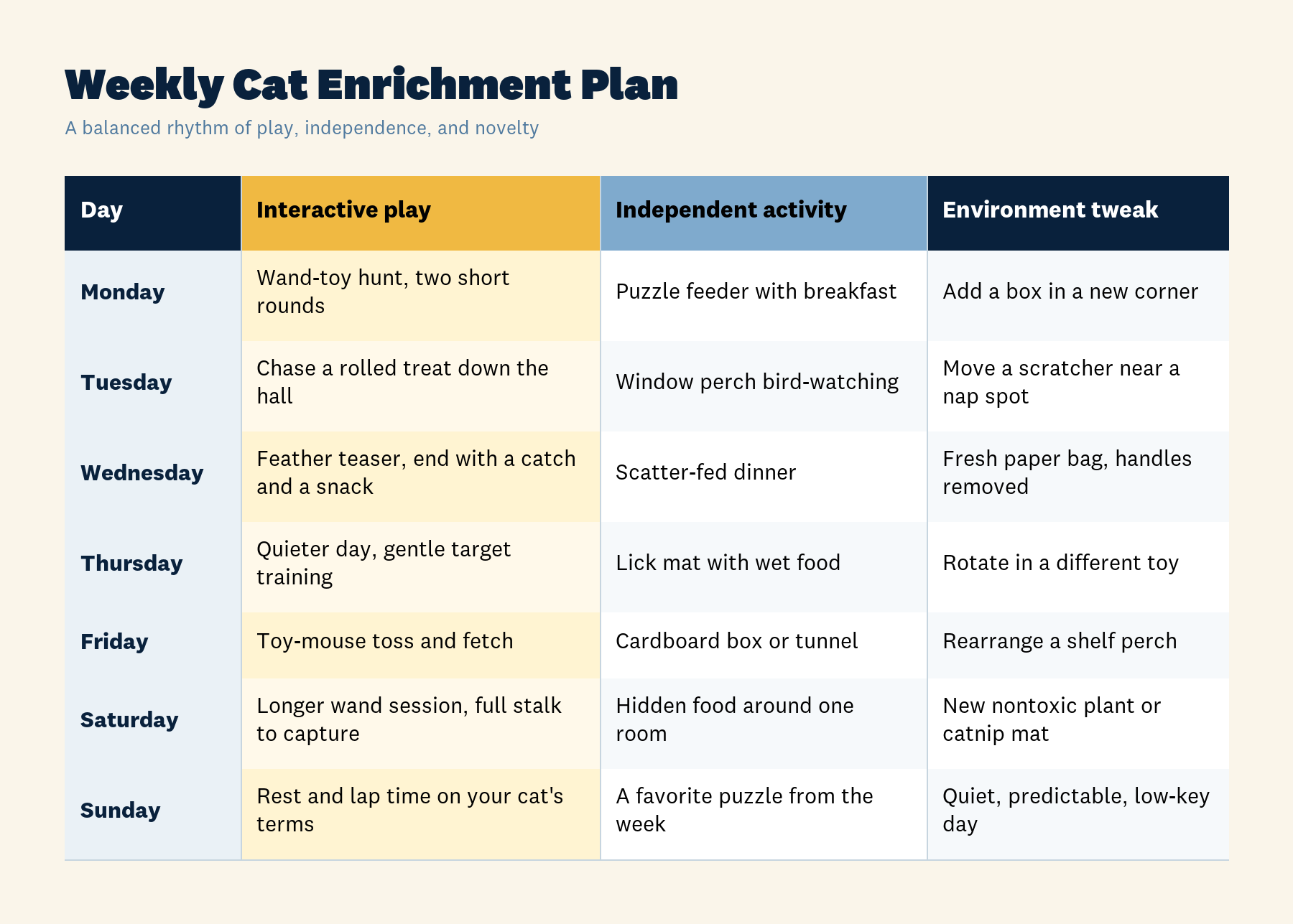
Enrichment works best as a light daily habit, not a big weekend project. Here's a sample week to borrow from, with one quick play session, one thing your cat can do on their own, and one small change to the environment each day. Treat it as a menu rather than a rulebook, repeat whatever your cat loves, and use measured food and treats so the extras don't pile on calories. Build in a quieter day when your cat seems tired.
Signs to Adjust the Activity or Call a Veterinarian
Enrichment should leave your cat satisfied, not stressed. Wind an activity down or stop it if your cat freezes, bolts for a hiding spot, goes tense, pants, vocalizes oddly, redirects onto another pet, or can't seem to settle afterward. Fun and overstimulation can look alike for a moment, so watch which way your cat tips.
Some changes call for a vet, not a new toy. Book a check-up for any sudden or lasting change in appetite, litter-box habits, grooming, sleep, movement, hiding, temper, or interest in play. A drop in activity is easy to read as boredom when the cause is pain, illness, fear, or tension with another animal. When something seems off, let your vet rule out a medical reason first.
Frequently Asked Questions
How much enrichment does an indoor cat need?
No single number, but most do well with a couple of short play sessions a day, daily places to climb and scratch, a hiding spot or two, and a food puzzle. A little every day beats an occasional big burst, adjusted to your cat's age and energy.
What are inexpensive cat enrichment ideas?
Some of the best cost almost nothing. A cardboard box, a handle-free paper bag, a toilet-paper tube stuffed with kibble, or dinner scattered for your cat to hunt down all work. A window view and a homemade wand round it out.
How do I entertain a cat while I am at work?
Set up independent options before you leave, like a food puzzle with breakfast, a few hidden treats, a window perch, and a rotated toy or two. Most cats sleep much of the day, so aim for a few good things to wake up to.
Are food puzzles good for cats?
Yes, for most. They tap into natural foraging and work the mind, and they slow a fast eater down. Start easy, use measured food, and simplify or skip them if your cat gets frustrated or has a condition your vet is managing.
How often should I rotate cat toys?
Keep a small set out and swap every few days to a week. Putting a toy away and bringing it back later makes it feel new again. A clear favorite can stay out.
What activities are best for senior or shy cats?
For seniors, favor low, low-effort options like ground-level puzzles and gentle wand play, and rule out pain with your vet if activity drops. For shy cats, lean on predictable routines, hiding places, and calm play they can join or skip.
Are laser pointers safe for cats?
They can be, with care. Never aim at your cat's eyes, and always end by letting your cat catch a physical toy or treat. A dot that never gets caught can leave some cats frustrated, so the payoff at the end is the point.
How do I enrich a multi-cat home?
Plenty, spread out. Give each cat their own food, water, litter, resting spots, scratchers, and perches in different areas, so no one has to guard a shared resource. Separate play sessions and vertical space let cats share a room while keeping their distance.
Can enrichment help a bored cat?
Often, yes. A bored cat may over-groom, pester you, get destructive, or race around at night, and a richer routine frequently eases it. Rule out medical causes first, since some of those signs come from pain or illness rather than boredom.
When does a behavior change require a veterinarian?
Any time it's sudden or sticks around. Changes in eating, drinking, litter-box use, grooming, movement, hiding, or mood are reason enough to call, as is a cat who stops enjoying play they used to love. Enrichment supports a healthy cat, but it doesn't replace a vet's eye.
Support Your Cat with Trusted Pet Care
A rich environment goes a long way, and so does the right care when you can't be there. If you travel or work long hours, a trusted sitter can keep meals and play on schedule and the litter box clean, which spares an anxious cat the upheaval of a strange place. Yourgi connects you with vetted Pros, whether you need someone to look in on your cat or a longer stay through in-home boarding. Every booking is backed by the Yourgi Guarantee. Booking through Yourgi also earns Yourgi Rewards toward future care.
For anything health-related, though, your vet comes first. Loop them in for questions about feeding, weight, mobility, or any behavior change that has you concerned, and lean on enrichment as the day-to-day layer that keeps a healthy cat happy.